What the law actually requires, what lawsuits really look like, and how museums can respond without panic
At some point in every accessibility conversation, someone asks the question out loud, or at least thinks it:
“Are we exposed?”
Up to this point in the series, we have talked about usability, standards, costs, tools, audits, and operational reality. This article addresses the pressure that often sits beneath all of that. Legal risk.
Accessibility discussions often change tone when the legal dimension enters the room. What was previously a thoughtful conversation about users and trade-offs can quickly turn into a scramble for certainty. Absolute compliance. Maximum coverage. Anything that feels like protection.
That reaction is understandable. It is also often counterproductive.
This article is about grounding legal risk in reality. What the law actually says. What accessibility lawsuits usually involve. How museums are typically affected. And how institutions can take defensible, proportionate action without letting fear dictate their accessibility strategy.
What the Law Actually Covers
In the United States, website accessibility enforcement is not governed by a single, tidy statute written specifically for the web. Instead, it has evolved through interpretation, guidance, and case law, primarily under the Americans with Disabilities Act.
Title III of the ADA prohibits discrimination on the basis of disability in places of public accommodation. Museums, as public-facing institutions, generally fall within that category. The complication is that the ADA was passed in 1990, long before modern websites existed. It does not explicitly mention websites. Courts and regulators have filled that gap over time by interpreting websites as part of the services offered by public accommodations.
The U.S. Department of Justice has repeatedly stated that websites should be accessible, even though it has not issued formal, binding technical regulations specifying exactly how.
In practice, WCAG AA has become the de facto reference point. Not because it is written into law, but because it is widely accepted as a reasonable technical standard.
This distinction matters. It means legal exposure is about reasonableness and access, not about checking every box on a technical specification.
What Accessibility Lawsuits Usually Look Like
Most accessibility lawsuits do not begin with a trial. They begin with a demand letter.
These letters typically allege that a website is inaccessible to users with disabilities and therefore violates the ADA. They often reference WCAG. They may cite specific issues. They usually include a request for remediation and legal fees.
A large number of these letters are sent by a small number of firms. Many are never followed by formal litigation. Some are, but most cases settle long before reaching a courtroom.
When cases do proceed, the outcomes are often narrow. Courts rarely require perfection. They focus on whether users can reasonably access goods and services. Importantly for museums, there are relatively few fully litigated cases involving cultural institutions compared to retail, hospitality, and financial services. Museums are not immune, but they are not the primary targets.
That does not mean risk should be ignored. It means risk should be assessed proportionately.
Where Museums Tend to Be Most Exposed
Legal exposure tends to cluster around specific types of failures.
Complete barriers to access carry the highest risk. A navigation system that cannot be used without a mouse. Forms that cannot be submitted with assistive technology. Videos that convey essential information without captions. These are Level A failures. They block access entirely.
The next tier of risk involves usability breakdowns that significantly impair access. Poor contrast. Invisible focus indicators. Inconsistent navigation. Unclear error messaging. These issues align with Level AA expectations and are commonly cited in complaints.
By contrast, failures to meet more advanced or aspirational criteria are rarely the sole basis of legal action, especially when institutions can demonstrate good-faith efforts to improve access.
This pattern reinforces a theme that has run through the entire series: basic usability matters more legally than theoretical completeness.
The Cost of Overreacting
One of the most common responses to perceived legal risk is overcommitment.
Museums promise full WCAG 2.2 AAA compliance across their entire website. They pursue expensive audits without a plan for remediation. They install overlays believing they provide legal protection. They drain budgets and staff energy chasing certainty that does not actually exist.
This approach creates two problems.
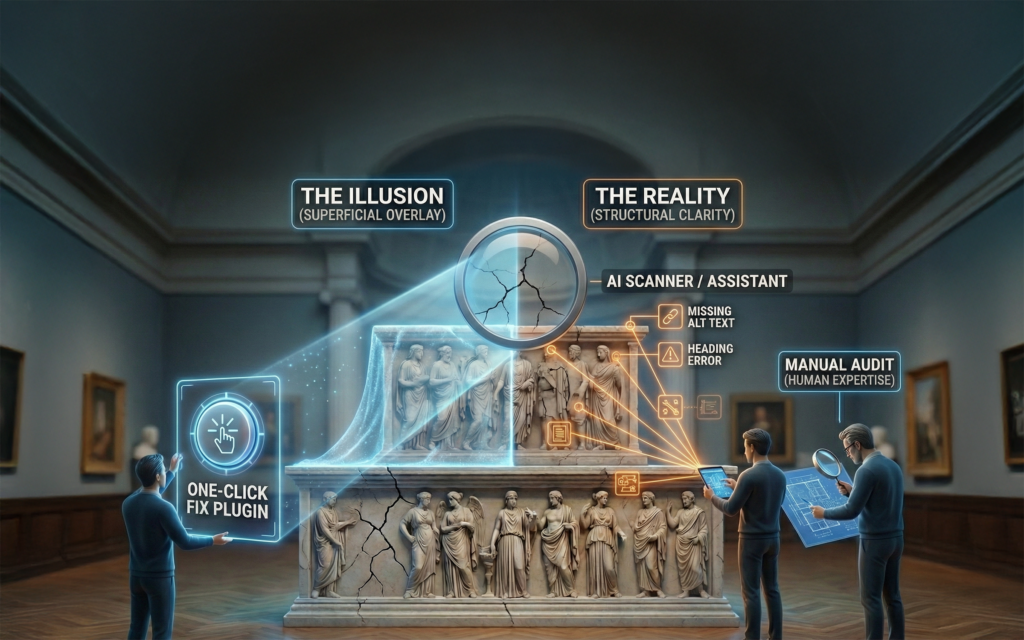
First, it often fails to meaningfully reduce risk. Overlays do not fix structural issues. AAA commitments are difficult to sustain. Audits without follow-through do not improve usability.
Second, it diverts resources from changes that would actually help users. Time spent rewriting perfectly usable content to satisfy edge-case criteria is time not spent fixing broken navigation or unreadable pages.
Legal defensibility is not about perfection. It is about reasonable, documented effort.
What a Defensible Accessibility Posture Looks Like
Museums that respond well to legal risk tend to do a few things consistently.
They fix obvious barriers quickly. Keyboard traps, missing labels, inaccessible navigation, and missing captions are addressed as a priority.
They target WCAG AA deliberately, especially for templates and high-traffic pages. This aligns with how accessibility is evaluated in practice and with how complaints are typically framed.
They document their efforts. Accessibility statements that reflect real work, audit summaries, remediation plans, and ongoing improvements matter. They demonstrate good faith.
They avoid making promises they cannot keep. Vague statements about “full compliance” are replaced with clear descriptions of scope and intent.
They understand that legal risk is reduced not by claims, but by usability. This posture does not eliminate risk. It makes risk manageable and defensible.
Where AI Helps From a Legal Perspective
AI does not provide legal protection. But it can strengthen a museum’s posture in practical ways.
By catching accessibility issues before publication, AI reduces the likelihood that new content introduces obvious barriers. That alone lowers exposure over time.
By assisting with alt text, captions, and content review, AI helps ensure that accessibility improvements are applied consistently rather than sporadically.
By supporting documentation and internal guidance, AI helps maintain continuity as staff change. This matters when institutions need to demonstrate ongoing effort rather than one-time fixes.
From a legal standpoint, consistency and process matter. AI can support both.
Responding to a Demand Letter Without Panic
If a museum does receive a demand letter, the worst response is paralysis or overreaction. The most effective responses are measured.
First, assess the claims. Are they specific? Do they identify real barriers? Or are they generic?
Second, review the site honestly. Are there Level A or clear AA issues that need immediate attention? Fixing them promptly often resolves the substance of the complaint.
Third, engage legal counsel who understands accessibility, not just litigation. Many demand letters are resolved through remediation commitments rather than court action. For a list of defense attorneys who understand ADA related accessibility claims refer to accessible.org’s list of attorneys.
Finally, treat the moment as an opportunity to strengthen systems, not just to quiet a threat. Institutions that respond calmly and constructively are often better positioned than those that react defensively.
Accessibility as Risk Management, Not Risk Avoidance
The uncomfortable truth is that no public-facing website is risk-free. Museums cannot eliminate legal exposure entirely. They can reduce it intelligently.
The most effective accessibility strategies balance mission, usability, cost, and legal reality. They prioritize access for real users. They invest where impact is highest. They document their work. They avoid fear-driven decisions.
Accessibility pursued this way is not just ethically sound. It is strategically sound.
Closing the Series
Across this series, we have deliberately avoided treating accessibility as a checklist or a panic response.
We have framed it as usability.
As stewardship.
As an ongoing practice shaped by real constraints.
For museum websites, that framing is essential.
Accessibility is not about being perfect. It is about being usable, inclusive, and honest about what you can sustain.
That is what ultimately serves users. And it is what ultimately holds up under scrutiny.